
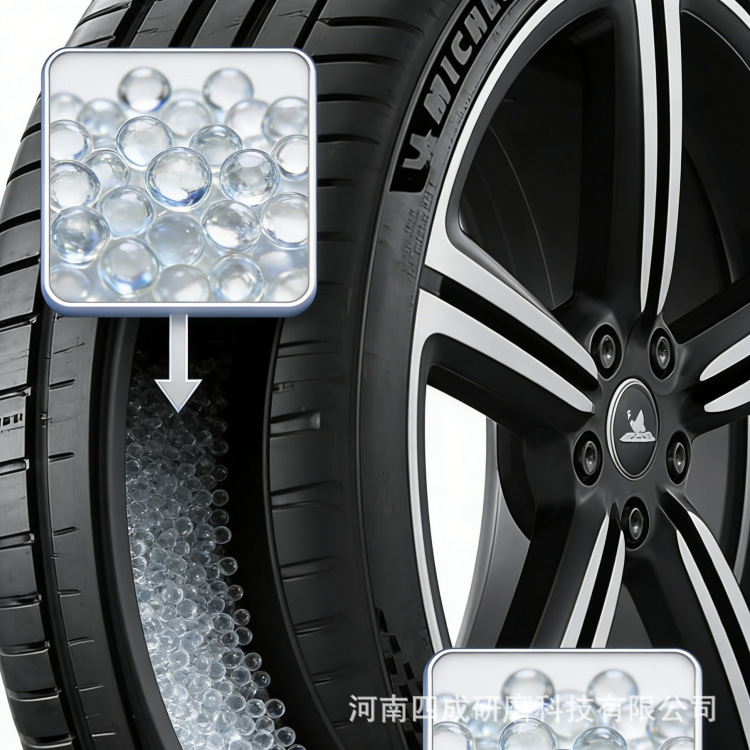
Tire balancing glass beads are small, tempered solid glass spheres inserted into tire cavities to provide dynamic self-balancing while driving, replacing or supplementing traditional lead wheel weights.


1. Working Principle
- Installation: Beads are poured into the tire (via valve stem or during mounting).
- At speed (>30–40 km/h): Centrifugal force flings beads against the inner tire wall.
- Self-adjusting: Beads roll toward the lighter side (low centrifugal force) and accumulate there, adding weight to counterbalance imbalance—real‑time dynamic balancing.
- Continuous correction: Re‑distribute automatically as tires wear, deform, or pick up debris.
2. Key Specifications (Tire Grade)
- Material: High‑purity tempered soda‑lime/borosilicate glass (SiO₂ ≥70%).
- Hardness: Mohs 6–7 (resists breaking/abrasion).
- Sphericity: ≥95% true sphere (free rolling, no clumping).
- Size (common):
- 1–2 mm: Passenger cars, motorcycles.
- 2.5–3 mm: Trucks, buses, heavy equipment.
- Density: ~2.5 g/cm³.
- Coating: Silicone/anti‑stick (prevents moisture/static clumping).
| Vehicle Type | Bead Size | Quantity per Tire |
|---|---|---|
| Passenger car / SUV | 1–2 mm | 30–60 g |
| Motorcycle | 1–2 mm | 15–30 g |
| Light truck | 2–2.5 mm | 60–100 g |
| Heavy truck / Bus | 2.5–3 mm | 100–150 g |
| Off‑road / Agricultural | 2.5–3 mm | 80–120 g |
4. Advantages
- Dynamic self‑balancing: Adapts to tire wear, cuts, and uneven loading for life‑of‑tire performance.
- No wheel weights: Protects alloy wheels from damage; eliminates lead pollution.
- Smoother ride: Reduces vibration at all speeds, improves handling.
- Longer tire life: Minimizes irregular tread wear.
- Easy installation: Add via valve stem (no tire removal needed).